
קרקסון
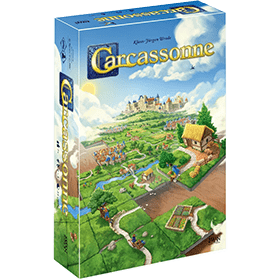 קרקסון הוא משחק הנחת אריחים בו השחקנים ממלאים את האזור הכפרי מסביב לעיר המבוצרת.
הם יניחו אריחים ויציבו עוקבים על דרכים ובתוך ערים, מנזרים, ושדות.
שחקנים זוכים בנקודות על ידי עוקבים בתוואי שטח, לאחר השלמת התוואים. שחקן המבצע את המיקומים האסטרטגיים ביותר של אריחים ועוקבים יזכה בהכי הרבה נקודות וינצח במשחק.
קרקסון זכה בפרס "שפיל דס יאהרס" המפורסם לשנת 2001 והוא בין המשחקים המובילים בעולם.
מספר שחקנים: 2 - 5
משך המשחק: 15 mn
מורכבות: 1 / 5
שחקקרקסון ו1401 משחקים אחרים ברשת.
אין צורך בהורדה - שחק ישירות מהדפדפן.
עם חברים ואלפי שחקנים מכל העולם.
חופשי.


שחקקרקסון ו1401 משחקים אחרים ברשת.
אין צורך בהורדה - שחק ישירות מהדפדפן.
עם חברים ואלפי שחקנים מכל העולם.
חופשי.
תקציר החוקים
Overview
Carcassonne is a tile-placement game. Players take turns expanding the landscape of roads, cities, monasteries, and fields, one tile at a time, to build the city of Carcassonne. Meeples are used to occupy various features. The player(s) with the most meeples on a feature score points.
Gameplay
1. Place a Tile
On your turn, you must place a tile in such a way that it continues the landscape features of any tiles it touches. BGA will prevent you from placing a tile adjacent to any incompatible tiles.
Each of the four edges of the tile will have one of three features: City, Road, or Farm. Monastery only appears in the center of a tile.
2. Place a Meeple (optional)
You can place a meeple somewhere on the tile. It stays on that tile until that feature is scored. You cannot place a meeple on a feature that already has other meeples. But you can get multiple meeples on a single feature if they start them as separate features, then later a tile is placed that joins them.
3. Score (if feature is completed)
Scoring occurs only when a feature is completed or when there are no more tiles to place (i.e., the game ends). Only the player who has a meeple occupying the feature can score. If the feature has more than one meeple, the player with the most meeples on that feature gets the points. In ties, each player gets full points.
When a feature is completed and scored, the meeples on it return to their players' supply.
| Feature | Image | Completion Criteria | Score | Term for occupant |
|---|---|---|---|---|
| Road | 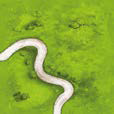 |
Each end must meet a village, a city, a monastery, or loop back onto itself. | Each tile of the road grants 1 VP. | Highwayman |
| City | 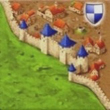 |
Every side has a wall with no gaps inside. Cities cannot be joined corner to corner. | 2 VP per tile + 2 VP per blue shield (coat of arms) in the city. | Knight |
| Monastery | 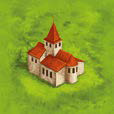 |
Surrounded by tiles on all sides and corners (8 tiles). | 9 points (one per tile surrounding the monastery plus the monastery itself). | Monk |
Game End and Final Scoring
The game ends when a player can no longer take or place a tile. At that point, incomplete features with meeples on them are scored.
| Feature | Image | Score for incomplete feature |
|---|---|---|
| Road | |
Each tile of the road grants 1 point. |
| City | 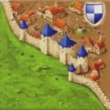 |
1 point per tile + 1 point per blue shield (coat of arms) |
| Monastery | |
Each tile surrounding the monastery, plus the monastery itself, is worth 1 point. |
| Farm | 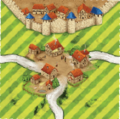 |
3 points per completed city that touches the field. |
Variants
The River
In The River variant, all river tiles  are played first, creating one long river from which to start the rest of the game.
Inns & Cathedrals (Expansion 1)
This expansion includes city tiles with cathedrals 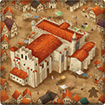 and road tiles with inns
 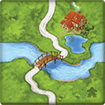 , plus large meeples.
- A completed road with an inn on it scores 2 VP per tile (final scoring is still 1 VP per tile for an incomplete road).
- A completed city with a cathedral in it scores 3 VP per tile (final scoring is still 1 VP per tile for an incomplete city).
- You may choose to place a large meeple on a feature. A large meeple counts as 2 regular meeples when deciding who controls the feature. Large meeples don't change how the feature is scored.
Traders & Builders (Expansion 2)
This expansion includes goods tokens, builder meeples, and pig meeples.
- When you place a meeple on a road or city, you may also add the builder meeple. If you place a tile that adds to the road or city that the builder is occupying, you may take a second turn. Then the builder is returned to your supply. Builders do not count toward feature control or scoring.
- When you place a meeple in a field, you may also add the pig meeple. If you complete a city with at least 1 blue shield, you score 3 points for each completed city touching the field with your pig. Feature control is not a factor--all players with pigs score. Pigs do not count toward feature control or final scoring.
- If you complete a city, for each goods symbol shown in that city, you receive 1 corresponding goods token. It does not matter if you have a meeple occupying that city or not. The city scores as normal.
- During final scoring, if you have collected the most goods of that type, you score 10 points.
The Princess & the Dragon (Expansion 3)
This expansion puts Carcassonne in the world of high fantasy, with dragons, fairies, and magic portals.
- When playing a tile with a magic portal on it
 , you may place a meeple on any tile that has already been played (following normal placement rules).
 - When you play a tile with a princess on it
 to an existing city, you may remove another player's meeple from that city instead of placing one of your own.
 - When you play a tile with a volcano on it
 , immediately add the dragon to this tile. Meeples cannot be placed on a volcano.
 - When you play a tile with a dragon on it
 , players take turns moving the dragon meeple until it moves 6 times or cannot move.
 - The dragon must move orthogonally, not diagonally (only north, south, east, or west).
- Any meeples on tiles the dragon visits are eaten and replaced in the player's supply.
- The dragon cannot visit the same tile twice in the same turn (no backtracking).
- The dragon cannot visit the tile with the fairy.
- Meeples cannot be placed on the same tiles as the dragon.
- If the dragon is not on the game board (i.e., no volcano tiles have been played), this icon is ignored.
- If you cannot or choose not to add/move a meeple to any tile, you may instead move the fairy meeple to one of your meeples.
- If the fairy is still assigned to your meeple at the start of your turn, you immediately score 1 VP.
- If your meeple and the fairy are on a tile when its feature is completed, you get 3 VP, regardless of whether you control the feature.
- The dragon cannot enter a tile with the fairy on it. All figures on the fairy's tile are protected from the dragon's hunger.